Posted on January 30, 2012 by Archer USMLE Reviews
318) A 55 year old woman underwent a debulking surgery with total abdominal hysterectomy, Salpingo-oophorectomy, omentectomy and appendicectomy for a recently diagnosed Stage IIIC Epithelial Ovarian Cancer. Her intra-operative course was complicated by severe blood loss and she received about 15 units of Packed Red Blood Cells. She is currently in the intensive care unit. Six hours after surgery, her blood pressure drops to 80/50 mm Hg. On examination, she is afebrile. She is drowsy but can be awakened. She denies any chest pain or shortness of breath. She has muscle tremors. Chest is clear to auscultation. Abdominal sutures are intact with no clinical evidence of Hematoma. An electrocardiogram is shown below:

Which of the following is the most likely explanation of the patient’s acute findings?
A) Hyperkalemia
B) Acute Myocardial Infarction
C) Circulatory Overload
D) Transfusion Associated Acute Lung injury
E) Citrate Toxicity
Filed under: Uncategorized, USMLE Test Prep | Tagged: ARCHER ACID-BASE, Archer cardiology, ARCHER FLUID AND ELECTROLYTES, Archer hematology, ARCHER NEPHROLOGY, dr.red nephrology lecture, Hematology, USMLE STEP 3 CARDIOLOGY, USMLE step 3 Hematology, usmle step 3 nephrology | 5 Comments »
Posted on January 30, 2012 by Archer USMLE Reviews
317) A 68-year-old african-american man with history of NYHA Class III congestive heart failure presents to your office for a follow up visit. His other medical problems include Hypertension, Stage II chronic kidney disease and Coronary artery disease. During his office visit three months ago , she was noted to have moderate hyperkalemia. At that time, his medications were adjusted which involved discontinuation of spironolactone and dose-reduction of ACE inhibitor. His other medications included Atenolol and Aspirin. She reports that she was admitted to hospital two weeks ago with severe hyperkalemia. He denies any complaints at this time. A serum potassium level is 4.5mEq/l , serum creatinine 1.8mg% and most recent echocardiogram revealed a left ventricular ejection fraction of 35% . His current medications include Atenolol, Hydrochlorthiazide and Aspirin. Which of the following is the most appropriate next step?
A) Re-start ACE inhibitor at a lower dose
B) Start Angiotensin Receptor Blocker (ARB)
C) Start Hydralazine and Isosorbide
D) Continue current medications
E) Start Spironolactone
Filed under: Uncategorized, USMLE Test Prep | Tagged: ARCHER ACID-BASE, Archer cardiology, ARCHER FLUID AND ELECTROLYTES, ARCHER NEPHROLOGY, dr.red nephrology lecture, USMLE STEP 3 CARDIOLOGY, usmle step 3 nephrology | 8 Comments »
Posted on January 30, 2012 by Archer USMLE Reviews
316) A 72-year-old man was admitted to the hospital with right leg deep vein thrombosis. He has a history of prostate cancer, well-controlled diabetes and mild renal insufficiency. His baseline creatinine is usually between 1.4 to 1.6mg%. His laboratory investigations at admission were normal except for increased creatinine at 1.4mg% . Venous doppler showed leg femoral deep vein thrombosis in femoral vein. He was started on Heparin drip and oral warfarin. Three days after admission, the patient develops persistent hyperkalemia (6.5 to 7.0 mEq/l). Rest of his electrolytes are normal and renal function is at his baseline. His INR ( International Normalized Ratio) is 1.4. There are no EKG abnormalities. His Urine Osmolality is 300mOsm/kg, Urine K 20 mmol/L and Serum Osmolality 280 mOsm/kg. He is given insulin and dextrose therapy however, hyperkalemia persists. Which of the following is the most appropriate next step in management?
A) Start Kayexalate
B) Discontinue Heparin and Start Enoxaparin
C) Discontinue Heparin and place Green field filter
D) Hemodilaysis
E) Intravenous Sodium bicarbonate
Filed under: Uncategorized, USMLE Test Prep | Tagged: ARCHER ACID-BASE, Archer emergency medicine, ARCHER FLUID AND ELECTROLYTES, ARCHER NEPHROLOGY, dr.red nephrology lecture, usmle step 3 nephrology | 8 Comments »
Posted on January 30, 2012 by Archer USMLE Reviews
315) A 64-year-old man with history of diabetes mellitus is evaluated in your office during a follow-up visit . He was admitted to the hospital one week ago because of incidentally discovered high serum potassium of 7.0mEq/L on his routine labs. He has history of hypertension and Stage I chronic kidney disease . His medications prior to the hospital admission included glyburide and enalapril. However, Enalapril was discontinued and he was started on hydrochlorthiazide during that admission. He denies any complaints at this time. A serum potassium level is 4.5mEq/l , serum creatinine 1.8mg% and urinalysis reveals proteinuria. 24 hour urine collection reveals 300mg proteinuria/24hrs. Which of the following is the most appropriate next step?
A) Re-start Enalapril at 50% of previous dose
B) Start Losartan
C) Start Hydralazine and Isosorbide
D) Start Spironolactone
E) Renal biopsy
Filed under: Uncategorized, USMLE Test Prep | Tagged: ARCHER ACID-BASE, ARCHER FLUID AND ELECTROLYTES, ARCHER NEPHROLOGY, dr.red nephrology lecture, usmle step 3 nephrology | 10 Comments »
Posted on January 30, 2012 by Archer USMLE Reviews
314) A 70-year-old man presented to the Emergency room with a 2-day history of increased thirst and frequency of urination. He reports generalized muscle weakness. His past medical history is significant for hypertension, diabetes mellitus and Stage III chronic kidney disease. His medications include Insulin Glargine, Lispro insulin, Enalapril , Atenolol and Spironolactone. Laboratory investigations reveal
Blood glucose 400mg%
Sodium 130 mEq/L
Potassium 7.5 mEq/L
Bicarbonate 26mEq/L
Chloride 100mEq/L
Creatinine 4.2mg%
An electrocardiogram is shown below:
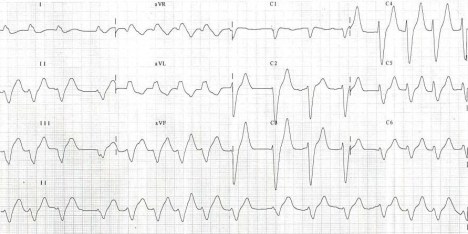
Which of the following is the most appropriate next step?
A) Reduce the dose of Enalapril
B) Hemodialysis
C) Insulin Intravenous
D) Calcium Gluconate IV
E) Sodium biacrbonate IV
Filed under: Uncategorized, USMLE Test Prep | Tagged: ARCHER ACID-BASE, Archer cardiology, ARCHER ELECTROCARDIOGRAMS, ARCHER FLUID AND ELECTROLYTES, ARCHER NEPHROLOGY, dr.red nephrology lecture, USMLE ELECTROCARDIOGRAMS, USMLE STEP 3 CARDIOLOGY, usmle step 3 nephrology | 11 Comments »
Posted on May 23, 2011 by Archer USMLE Reviews
157) A 25 year old woman presents to your office with complaints of muscle cramps and weakness. She smokes 1 pack cigarettes per day and chews tobacco and flavored gum. She also has history of alcoholism and ingests about one pint of vodka every day for the past 2 years. She also uses “Ecstasy” during weekend parties. She has a history of snoring in the night. On examination, afebrile, heart rate is 88/min and blood pressure is 150/98. Laboratory investigations reveal a Sodium of 144 meq/L, potassium of 3.0meq/L, Chloride 98meq/L , Bicarbonate of 34meq/L and Creatinine of 0.8mg%. Urinary chloride is 45meq/L. Which of the following points in the patient’s history is most helpful in diagnosing her condition?
A) Alcohol use
B) Chewing tobacco and flavored gum
C) Snoring in the night
D) Smoking
E) Use of Ecstasy
Filed under: USMLE Test Prep | Tagged: ARCHER ACID-BASE, ARCHER FLUID AND ELECTROLYTES, ARCHER NEPHROLOGY, archer usmle step 3 | 6 Comments »
Posted on May 23, 2011 by Archer USMLE Reviews
156) A 25 year old woman presents to your office with complaints of muscle cramps and weakness. On examination, she is afebrile, heart rate is 88/min and blood pressure is 150/98. Ophthalmoscopic examination shows the following :
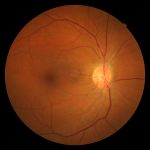
Laboratory investigations reveal a Sodium of 144 meq/L, potassium of 3.0meq/L, Chloride 98meq/L , Bicarbonate of 34meq/L and Creatinine of 0.8mg%. Urinary chloride is 45meq/L. The most likely diagnosis that explains this patient’s clinical features :
A) Gitelman’s syndrome
B) Chronic Laxative abuse
C) Diuretic Abuse
D) Primary Hyperaldosteronism
E) Bartter’s syndrome
Filed under: USMLE Test Prep | Tagged: ARCHER ACID-BASE, ARCHER FLUID AND ELECTROLYTES, ARCHER NEPHROLOGY, archer usmle step 3 | 3 Comments »





 Archer USMLE Step 3 Blog