Question of the Week # 67, 68

Q67) A 44 year old woman presents to your office with pain and swelling of the small joints in his hands and wrists. The symptoms have been progressing over the past 4 months. She denies any fever or weightloss. She reports stiffness in his both hands that occurs every morning and lasts for 2 hours. On examination, she has symmetrical involvement of both the wrists and two of her left proximal interphalangeal joints. The involved joints are swollen and tender. Laboratory tests shows normal ESR, negative rheumatoid factor, and a negative anti-CCP antibody. X-ray of the wrist and hands reveal mild joint space narrowing with only very small peripheral erosions. The most appropriate next step in management :

A. Prednisone
B. Start NSAID and follow-up in one month.
C. Start NSAID and Methotrexate
D. Start Infliximab
E. Start NSAID and Hydroxychloroquine

Q68) The patient in the above question is started on appropriate therapy. He returns to your clinic in 1 month for regular follow up and his disease is well controlled with near complete remission. The most important next step in follow up of this patient :

A. DEXA scan in 1 year
B. PPD placement
C. Check hepatitis B serology
D. Ophthalmology referral at 3 months
E. Liver function tests

Question of the Week # 61

A 24 year old woman presents to the Emergency Room with complaints of  left sided weakness and slurred speech. The patient has history of Systemic Lupus Erythematosus. Her SLE was diagnosed 2 years ago when she had malar rash and abnormal blood counts. She reports that she has not received any treatment for it since her physician felt this was not needed at that time. She denies any history of kidney involvement. She denies any joint pains or rash. Physical examination revealed left hemiparesis consistent with cerebrovascular accident. A CT of the head reveals right parietal infarct with out any bleed. An EKG is obtained and is normal.  Anti-cardiolipin antibody is +ve which was also positive 1 year ago as per her old records . The patient is started on adequate therapy and follows up in your office 1 month later. Which of the following interventions is most appropriate to prevent recurrent stroke in her case?

a)        Aspirin  for life

b)       Warfarin for 1 year

c)        Warfarin for 6 months

d)       Warfarin for life

e)        Hydroxychloroquine

Question of the Week # 60

A middle aged man presents with a history of foot pain on walking for a few weeks. The patient has a history of long standing diabetes mellitus for more than 15 years. He has been on Metformin and Glyburide combination. His HGBA1C that was obtained 3 months ago revealed inadequate control  at 9%. He reports pain and swelling in his right foot for about one month.  On examination the foot is swollen & tender to touch. Neurlogical examination reveals loss of vibratory sensation and position sensation in bilateral feet. There is also impaired light touch until the level of knees bilaterally. Joint motion at the level of ankle is within normal limits. Complete blood count , creatinine and ESR are with in normal limits. Most likely working diagnosis for his right foot pain  is :

a)      Chronic  Gout

b)       Septic arthritis

c)        Peripheral Neuropathy

d)       Charcot arthropathy

e)       Reflex Sympathetic Dystrophy

Question of the Week # 58, 59

Q58) A 30 year old man comes to your office with complaints of pain in both the wrists and in the hands for the past two months. The pain is particularly worse in the nights and awakens him from sleep. It radiates to the forearms from the wrists.  Occassionally, the pain is associated with abnormal sensations in both hands.  He denies any pain or paresthesiae at this time. Upon further questioning, he also reports some mild stiffness & very mild pain in the neck in the past two weeks. Physical Examination is normal. The most appropriate initial investigation is:

A. Nerve conduction studies

B. Plain X-ray of the wrist

C. Plain X-ray of the cervical spine

D. Rheumatoid factor

E. MRI cervical spine

Q59) The most likely underlying etiology of this patient’s clinical features is :

A. Spinal cord compression

B. Brachial plexopathy

C. Rheumatoid arthritis

D. Hypothyroidism

E. Cervical Spondylosis

Question of the week # 56, 57

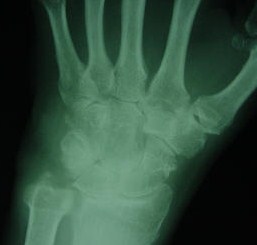
Q56) A 42 year old presents with a  pain & swelling in the left knee. The symptoms started 3days ago and have been progressively worsening. Upon further questioning, the patient tells you that he has experienced intermittent pain and swelling in the toes, wrists and ankles for more than 10 years. On examination the left knee is swollen and warm to touch. There is also soft tissue swelling of the wrists, ankles and right foot.  He has  a 10  year history of intermittent  pain & swelling in the toes, wrists & ankles. On examination the right knee is warm to touch with an effusion, & there is soft tissue swelling of the wrists, right ankle & right foot. X-ray of the wrist is shown below. Laboratory studies reveal increased ESR at 90mm/hr WBC are elevated at 12k.
The most likely diagnosis :

A. Early erosive osteoarthritis

B. Reactive Arthritis

C. Psoriatic Arthritis

D. Pseudo-Gout

E. Rheumatoid Arthritis

Q57) The most important next step in management :

A) Obtain Rheumatoid Factor level

B) Obtain Anti citrullin peptide level

C) Start prednisone

D) Start ibuprofen and Methotrexate

E) Arthrocentesis of the Right knee

Question of the Week # 53

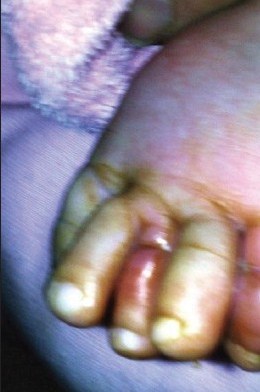
A 4-month-old girl is brought by her concerned mother  because the child has been inconsolably crying for 6 hours. The child is breast fed and has been doing well. There is no vomiting, diarrhea, constipation, or increased gas. The mother has not changed her diet and the infant is on no medications. There has been no fever. On physical examination the child is active and screaming. There is no fever.  The physical examination is normal except that there is redness and swelling affecting the left  third toe with indentation proximal to the redness. It is tender to touch. There was no history of similar problems.  The picture is shown below:


The most likely working diagnosis:

A. Trauma

B. Herpetic whitlow

C. Hairy tourniquet syndrome

D. Acute paronychia

E. Ingrown toe nail

F. Acute Gout

The most appropriate next step in management :

A. Joint aspiration

B. X-ray of the foot

C. Inspect the toe for hair strangulation

D. Incision and drainage

E. Topical acyclovir

Question of the week # 51

A 75 year old woman was diagnosed with Stage II breast cancer one year ago. The patient received chemotherapy, underwent modified radical mastectomy and radiation. . The cancer was ER+, PR+ and Her2-neu negative. The patient has been receiving Tamoxifen for the past few months. She reports that she has been experiencing vaginal spotting and intermittent mild vaginal bleeding over the past few months. She has also been experiencing intermittent hot flashes after starting Tamoxifen therapy. On physical examination, her vitals are with in normal limits. Pelvic examination does not reveal any gross pathology. Next step in managing this patient:
A. Stop Tamoxifen
B. Start oral progesterone
C. Obtain endometrial biopsy
D. Do a hysterosalpingogram
E. Recommend Hysterectomy with bilateral oophorectomy

Question of the Week # 50

A 50 year old woman with history of coronary artery disease and hypertension presents to your office for regular health check up. The patient is compliant with her medications which include aspirin, atorvastatin and enalapril. Her blood pressure is 110/70. Laboratory investigations including CBC and comprehensive metabolic panel are with in normal limits. A fasting lipid panel that was performed one week ago reveal an LDL cholesterol of 65, HDL of 50 and Triglycerides of 150. You discuss the results with her and you inform her that the goals of therapy are being adequately met. She seemed happy to know about the results but tells you that lately, her mood has been slightly low. There are good days but she tends to have frequent bad days as well. She enjoys surfing as she used to before. She has no weightloss and her appetite is good. She denies any suicidal ideations. She asks you if there is any medication that would benefit her heart and also, help her mood. The next best step in managing this patient is :

A. Start escitalopram
B. Start clozapine
C. Refer to psychiatrist
D. Start Omega 3 Fatty Acids
E. Start St.John’s Wort

Question of the Week # 49

A 45 year old woman presents to your clinic with history of intermittent epistaxis. Of late, this has become more frequent. The patient has a history of atrial fibrillation for which she has been taking aspirin as recommended by her cardiologist. She has no other past medical history. The patient also takes over the counter medications such as Vitamin b-complex which she thinks keeps her from getting tired. She says she also takes about 4 grams of Omega 3 fatty acids to keep “her heart healthy” and Ginkgo biloba to slow the “ageing of her brain”. Her laboratory tests reveal normal complete blood count. Prothrombin time and partial thromboplastin time are with in normal limits. Which of the following is your next step in managing this patient’s recurrent epistaxis?

A. Advise her to discontinue omega 3 fatty acids.
B. Discontinue Aspirin
C. Advise her to stop both Omega 3 fatty acids and Ginkgo biloba
D. Advise her to stop Ginkgo biloba
E. Advise her to stop Vitamin B-complex

Archer Step 3 CCS Workshop – Live Webinar – September 2011

Archer live Online CCS Workshop – September 2011


Archer Live Online USMLE Step3 CCS Workshops from http://www.CcsWorkshop.com

Archer is the only live CCS Workshop in which experienced Internal Medicine board certified physicians will teach you live how to apply unique high-yield CCS strategies to score the most in the CCS Component.

Archer online live step 3 reviews aims to bring USMLE step 3 courses on your desktop, at your doorstep! These highly successful live USMLE Step3 online reviews are an extension of our very popular and successful ” Dr.Red’s online ccs workshop, which has reached more than Twelve thousand step3 takers in less than 2 years and has resulted in 98% pass rate. Archer Reviews have achieved a high success rate even with examinees with multiple attempts by our unique approach. These online reviews are done live and in a webinar format. You can stay at home and listen to lectures live and like in a virtual classroom, you can raise your hand and your question will be immediately answered by the instructor. This is a live online classroom which reduces the pain of flying several miles to attend live reviews. These are the only one in the market that offer successful step 3 lectures in this unique, live format. Archer’s most successful endeavor has been Dr.Red’s CCS Workshop which has helped hundreds of examinees to pass easily by excelling on CCS component.

Archer’s next CCS online workshop for the month of September 2011 will be on Sunday 09/11/2011 at 10 AM EST.

If you are interested in registering for this course, you can pay for the course on the website at http://www.shop.ccsworkshop.com. Upon payment of the registration fee, your registration request will be automatically approved and an approval e-mail will be sent to you. This approval notice will have a button “Join Webinar” in it. Clicking this button on the day of the workshop will open up the live workshop on your desktop

To participate in the workshop, you will need a computer with internet access. For the audio, you can use either your computer’s microphone or a telephone. You will use the phone for the voice and log in to the conference call while you watch the power-point slides and the CCS demonstration on your desktop via. our unique net meeting software. You can also just opt to use your computer’s microphone in which case you do not need a telephone. Then you will get to practice a case while we watch and analyze your approach and correct it.

CCS Workshop Includes :

1. Lecture on CCS Strategies
2. Live demonstration of CCS cases
3. Common mistakes committed by the examinees and preventing them
4. Tips to score extremely high on CCS
5. Follow-ups of office and ER cases
6. Efficient use of time, doing more stuff without advancing the clock
7. Avoiding invasive tests
8. Basic set of orders for emergency cases
9. The 5-minute screen – adding/ disconinuing the orders that can matter
10. Obtaing consults and their appropriateness
11. Differential diagnosis for common ER and office presentations and easy tips to get the most out of few orders.
12. Working on efficiency
13. Live practice of 15 to 20 CCS cases by the attendees in the workshop
14. A these in addition to –> 20 minutes of supervised practice of one CCS case by each attendee who volunteers to practice. About 15 to 20 Highyield CCS cases will be practiced. During this time, you will be thoroughly analyzed, corrected and given instantaneous feedback by our experienced faculty

The total course fee is $97 .Slots are limited at 35.
If you are interested in the course, you visit Archer’s online store directly to pay : http://www.shop.ccsworkshop.com

If you have further questions, please directly contact support@ccsworkshop.com

Archer’s other courses include very informative topic reviews and the high-yield rapid review – please check our website. Next 3-Day Step 3 Rapid Review is in November -2011. Archer theory reviews are now available as streaming videos so that you can start accessing them from the beginning of your step 3 preperation and fine tune your conceptual understanding.

Question of the Week #48

A 55 year old man was recently found to have a 2.0 cm thyroid nodule on palpation during his annual physical. An ultrasound revealed no suspicious features of malignancy. TSH  and free T4 levels were normal. Patient denies any history of neck irradiation, pain, dysphagia or hemoptysis. There is no history of cancer in his family.  The next best step in evaluation of the nodule :

A. Suppressive therapy with levothyroxine

B. FNAC

C. Lobectomy with isthmectomy

D. Observation

E. Radio iodine therapy

Question of the week #46 and #47

1. A 55-year-old man presented for a regular follow-up to your office 2 weeks ago at which time a palpable nodule of 1.7 cm was noted in the left thyroid lobe. He denies a history of head and neck irradiation, hoarseness, pain, dysphagia, or hemoptysis. His physical exam is otherwise normal, with no lab abnormalities. Most appropriate next step in management?

A. Ultrasound of thyroid

B. TSH level

C. Fine Needle Aspiration ( FNAC)

D. Observation

E. Suppressive therapy with levothyroxine

2. The patient in Q1. subsequently, underwent an FNAC which revealed Papillary Carcinoma of thyroid. Staging work-up revealed no evidence of distant metastases and a neck CT scan does not reveal any lymphadenopathy. The most appropriate management of his thyroid cancer involves:

A. Radio iodine therapy ( RAI)

B. Partial thyroidectomy

C. Total thyroidectomy

D. Life long levothyroxine + Total Thyroidectomy + RAI therapy

E. Total Thyroidectomy + Life long levothyroxine

F. Partial thyroidectomy + life long levothyroxine

USMLE Step 3 CCS WORKSHOP

Most of the highyield CCS cases will be demonstrated with individual one on one practice in our monthly interactive CCS Workshops. Slots are limited and you  may register at http://shop.ccsworkshop.com

Archer USMLE Step 3 CCS Workshop – August 22, 2010

Archer USMLE Step 3 CCS Workshop – August 22, 2010

Archer online live step 3 reviews aims to bring USMLE step 3 courses on your desktop, at your doorstep! These highly successful live USMLE Step3 online reviews are an extension of our very popular and successful ” Dr.Red’s online ccs workshop, which has reached more than two thousand step3 takers in less than 12 months and has resulted in 98% pass rate. Archer Reviews have achieved a high success rate even with examinees with multiple attempts by our unique approach. These online reviews are done live and in a webinar format. You can stay at home and listen to lectures live and like in a virtual classroom, you can raise your hand and your question will be immediately answered by the instructor. This is a live online classroom which reduces the pain of flying several miles to attend live reviews. These are the only one in the market that offer successful step 3 lectures in this unique, live format. Archer’s most successful endeavor has been Dr.Red’s CCS Workshop which has helped hundreds of examinees to pass easily by excelling on CCS component.

Archer’s next CCS online workshop for the month of January will be on Sunday 8/22/2010 at 10 AM EST.

If you are interested in registering for this course, you can pay for the course on the website at http://www.shop.ccsworkshop.com. Upon payment of the registration fee, your registration request will be automatically approved and an approval e-mail will be sent to you. This approval notice will have a button “Join Webinar” in it. Clicking this button on the day of the workshop will open up the live workshop on your desktop

To participate in the workshop, you will need a computer with internet access. For the audio, you can use either your computer’s microphone or a telephone. You will use the phone for the voice and log in to the conference call while you watch the power-point slides and the CCS demonstration on your desktop via. our unique net meeting software. You can also just opt to use your computer’s microphone in which case you do not need a telephone. Then you will get to practice a case while we watch and analyze your approach and correct it.

CCS Workshop Includes :

1. Lecture on CCS Strategies
2. Live demonstration of CCS cases
3. Common mistakes committed by the examinees and preventing them
4. Tips to score extremely high on CCS
5. Follow-ups of office and ER cases
6. Efficient use of time, doing more stuff without advancing the clock
7. Avoiding invasive tests
8. Basic set of orders for emergency cases
9. The 5-minute screen – adding/ disconinuing the orders that can matter
10. Obtaing consults and their appropriateness
11. Differential diagnosis for common ER and office presentations and easy tips to get the most out of few orders.
12. Working on efficiency
13. Live practice of 15 to 20 CCS cases by the attendees in the workshop
14. A these in addition to –> 20 minutes of supervised practice of one CCS case by each attendee who volunteers to practice. About 15 to 20 Highyield CCS cases will be practiced. During this time, you will be thoroughly analyzed, corrected and given instantaneous feedback by our experienced faculty

The total course fee is $97 .Slots are limited at 35.
If you are interested in the course, you visit Archer’s online store directly to pay : http://www.shop.ccsworkshop.com

If you have further questions, please directly contact support@ccsworkshop.com

Archer’s other courses include very informative topic reviews and the high-yield rapid review – please check our website.. Archer theory reviews are now available as streaming videos so that you can start accessing them from the beginning of your step 3 preperation and fine tune your conceptual understanding to score maximum on the Multiple Choice Questions on USMLE Step 3

Question of the Week # 44

A 24 y/o athlete presents to your office with complaints of reddish discoloration of urine. He claims that he has been exercising and running vigorously for the past two days. He is very determined to lose the extra weight that he has put up in the recent months and has been fasting in the nights for the past one week. His past medical history is significant for two abdominal surgeries which included laparotomy and appendicectomy in the past for intermittent severe abdominal pain. The patient does not smoke but does occassional consumes alcohol in binges. He did involve in one such alcohol binge last night. Physical examination is benign except for decreased power and reflexes in bilateral lower extremities. There is no rash. His urine specimen was grossly red in color. Urine dipstick was negative for protein, blood, leucoesterase and nitrite. Urine microscopy did not reveal any RBCs, WBCs or Casts. Serum creatinine and complete blood count are with in normal limits. A Creatinine Phosphokinase ( CPK) level has been ordered but is not yet available. The most likely cause of this patient’s grossly red urine is :

A) Rhabdomyolysis
B) Paroxysmal Nocturnal Hemoglobinuria
C) Acute Intermittent Porphyria
D) Await CPK level for correct diagnosis
E) Glomerulonephritis

Question of the Week # 43

A 55 y/o woman with history of well controlled DM Type II presents for her regular follow-up visit. She has no new complaints. She has been well controlled on Metformin alone with a hemoglobin A1c of 6.5. The patient is afebrile with a B.P 96/72, HR 88, RR 16. Physical examination is benign except for decreased sensation in her bilateral lower extremities consistent with diabetic neuropathy and bilater lower extremity edema. Her last urinary microalbumin about one year ago was negative. A repeat dipstick test now is positive for protein and blood but negative for leucoesterase and nitrite. Subsequent urine microscopy reveals 4 dysmorphic RBCs/HPF and red cell casts. Labs reveal elevated serum creatinine at 1.4 as opposed to her baseline creatinine of 0.8 6 months ago. The next important step in approaching this patient’s Renal Insufficiency is:

A) Obtain CPK level
B) 24 hour urine for microalbumin
C) Start ACE inhibitor
D) Repeat urinalysis in 3 months
E) Referral to Nephrologist and Renal biopsy
F) Start emperic antibiotic therapy for UTI

Question of the Week # 42

A 65 y/o man with history of chronic smoking and COPD presents for follow up visit in your office after being discharged from the hospital about three weeks ago. The patient was admitted and treated in the hospital for community acquired pneumonia and COPD exacerbation. During his hospital stay he was noted to have microscopic hematuria on routine urinalysis. The patient denies any symptoms now. His COPD is well controlled on tiotropium inhaler. His allergies include Isoniazid and Penicillin. Past medical history is significant for a positive PPD test ( latent tuberculosis) for which he has been on treatment with Rifampin for past three months. Physical examination is benign. Labarotory investigations reveal a normal CBC and serum creatinine. Dipstick is positive for blood. A repeat urinalysis during this visit reveals persistent microscopic hematuria with 3 RBCs/HPF. A urine cytology has been sent. The next appropriate step in evaluating this patient’s hematuria is:

A) Repeat urinalysis in 3 months
B) Urine cultures
C) Intravenos pyelogram
D) CT urogram and Cystoscopy
E) Stop Rifampin

Archer USMLE Step 3 HighYield Lecture Series

Pay-Per-View
Watch your favorite streaming video lectures at your own convenience!

ARCHER USMLE Step 3 Reviews
Pay-Per-View System

Missed out on recent Archer live online review?
You can now access them any time during the year!

You may have wanted to attend the recent live Archer Review. But your busy schedule probably did not permit it. Archer Review receives several e-mails each month to do additional CCS Workshop sessions as well as Rapid Reviews because of these scheduling concerns. But since we have limited number of teaching physicians, at this time, we are able to do only one live CCS Workshop per month and one live three-day rapid  review in 2 months. Archer Live Rapid Review is also a very exhausting three-day ( 30 hour ) session that some attendees feel very tired at the end of each day. Archer Review realizes your concerns and hence, Archer Review is now introducing the Pay-Per-View option in which you can access the streaming videos of our live session on your desktop at your own convenience. These recordings are exactly similar to the live webinar review in that you can see the Powerpoint presentation running on your desktop screen while you also listen to the instructor’s audio. 

Pay-Per-View FAQ

What is Pay-Per-View?
Pay-Per-View system allows you to access the streaming video lectures online at your convenience and watch them at your home on your own desktop. You may purchase the full length course or topic-wise access.

Can I watch a Demo?
Yes, please contact us if you wish to watch two one hour samples.

What lectures for USMLE Step 3 do you currently offer via. Pay-Per-View?
The lectures that are currently available via. Pay-Per-View are :

  • Archer Full length ( 36 hours) USMLE Step 3 Review Course.
  • Archer USMLE 3 Topic-Wise Lectures ( Hematology, Cardiology, Gastroenterology, Nephrology/Acid-base/Electrolytes, Pulmonology/Ventilators, Infectious diseases, Endocrinology, Neurology, Ethics, Rheumatology/ orthopedics/ sports medicine, Oncology, Preventive medicine, Psychiatry, Gynecology, Pediatrics and Dermatology )
  • A collection of two recent CCS Workshops + CCS Strategies – Covering about 20 CCS cases + discussions + demonstration of key high-scoring CCS strategies
  • A compilation of Ten Archer CCS Workshops – Covering 60 Highveld CCS Case demonstrations and Approach total 120 hours in length – at http://shop.ccsworkshop.com 
  •  Lectures for USMLE Step2 CK will be available very soon.

I really want to attend your CCS Workshop but the date you have on your website does not suit my schedule. Can you provide it as Pay-Per-View?
Archer CCS Workshop is an interactive workshop for USMLE Step 3 CCS and involves live practice. PPV options are available as listed above and give you the convenience of accessing and learning at your own pace.

What are these Video Lectures? Are they similar to your live reviews?
 These streaming video lectures are the recordings of our live webinar sessions. These are exactly similar to our live review in that you can see both the Powerpoint presentation ( a capture of the instructor’s desktop screen) as well as listen to the audio in conjunction with the Powerpoint presentation. This eliminates the need for looking at a hand out or notes while listening to the lecture as you can directly see the Powerpoint running on your screen.

Are we provided with any hand-outs or lecture notes?
Yes, you will be provided with relevant Archer USMLE Step 3 notes by e-mail once you purchase the streaming video for a particular topic or for the entire review.

Is Pay-Per-View more expensive than live review?
At this time,  Pay-Per-View is cheaper than the live reviews.

What are the benefits of Pay-Per-View over the Live review?
Live review needs to be attended at a designated time. Pay-per-view can be watched at your own convenience giving you time to learn according to your own pace.
In Pay-Per-View, you can pause and listen to a particular portion again. You can also listen to the same lecture almost two times with the “watch time” that we currently provide.

What are the limitations of Pay-Per-View when compared to Live Review?
During the live review, you can directly ask questions and talk with the instructor. There is no such possibility via. Pay-Per-View. However, you may send us questions by e-mail and our instructor will try and answer them in about 3 days.

What is “Watch Time”?
Watch time is the amount time you are provided to watch the lecture. You are approximately provided with a watch time that is much greater than the length of the review. This allows to rewind and replay certain portions of the lecture if you wish. Watch time will not expire when you exit the lecture. Any unused watch time will be stored in your account and you can use it on an other day. When you resume the lecture, make sure to forward the player to the point where you left off. You can also replay the previous session as long as you have sufficient watch time in your account
For each lecture, you will be provided with the duration of the lecture and the “Watch time” when you begin.

Will the “Watch time” ever expire?
The “Watch time” will expire if unused in “one week” after subscribing to a “Topic Review”. The Watch time for the full course will expire if unused in “Two month” of purchasing a full length course. However, if you have special requirements, you can request us to extend the expiry date.

Do I need any special system requirements to play these?
These are WMV files and will play with any Windows Media Player.

How about the Internet connection requirements?
Dial-Up connections are ok but broad band connection is preferred for uninterrupted access.

Do you have Question and Answer Sessions in the review?

Yes. CCS Workshop – PPV contains interaction with several attendees and discussion of very important questions and challenges that many attendees face on USMLE Step 3. These sessions accompany every case demonstration during the CCS Workshop. Archer Full Length USMLE Theory lectures contain Q and A sessions accompanying many high yield topics. Some of these questions are freely accessible through our free blogs http://www.usmlestep3blog.com or http://www.usmle3.com

What is the impact of your courses?
Archer review focuses on key strategies that are necessary to excel on Step 3. This include excelling on the CCS component and assuring above average performance on the USMLE Step 3 MCQs. Our lectures are based on the most updated guidelines. These lectures dissect the concept and present you the most simplified approach to answer the multiple choice questions. The dissection of the concepts is similar to the way concepts are separated and well-presented in our sample question bank posted in our blogs. By listening to the lectures, you understand why certain step is the most appropriate clinical strategy and also, will learn clinical scoring systems and evidence related to the best strategy. The clinical scoring systems and the evidence-based guidelines presented in the lectures will make complex Step 3 MCQs an easier task to deal with. That is the reason, Archer has achieved > 98% success rates on the board exams among its attendees. Archer reviews’ achievements are reflected in its huge customer base of more than 10,000 physicians with in just 2 years of inception, an increasing “word-of-mouth” recommendations from highly satisfied customers and its huge presence on very highly active social media groups on Facebook , LinkedIn and Twitter

You may  visit Pay-Per-View to sign up!

Thank you
Sincerely yours,
Support team,
Archer Online Reviews
USMLEGalaxy

Question of the Week # 39

•A 46-year-old fisherman and Vietnam veteran presented with a recurrent rash on his arms and legs and a painful, swollen area on his left leg of several days’ duration. The rash had been a problem for about two years and was treated with several courses of antibiotics for cellulitis. The patient reported that for the past two years his skin had been prone to blister and tear with minor trauma and that at times his urine appeared to be dark reddish in color. On examination, he had a slight fever and an area of cellulitis on his left leg. His face was erythematous. On his hands, arms, and legs were vesicles and small bullae, some crusted lesions, and hypopigmented and hyperpigmented macules. What is the most important next step in diagnosis?

A. ANA

B. Rheumatoid factor

C. Skin biopsy

D. Hepatitis C serology

E. Hepatitis B serology

Question of the Week # 38

A 45-year-old woman is very concerned about an eruption on her face. She has developed lesions on the cheeks and forehead over the last few months. They are not associated with itching.  The eruptions are worsened with by prologed exposure to sun, excessive stress and hot drinks. She denies any history of alcoholism. Physical examination reveals a papular eruptions with assocaited erythema, telangiectasia and  pustules. There are no lesions in any other areas except on her face.

What are my options?

The Most Likely Diagnosis :

A.Nodulo cystic acne

B. Rosacea

C.Porphyria Cutanea Tarda

D. Seborrheic Dermatitis

E. Cutaneous Lupus

The most apprpriate next step in management :

A) Topical Corticosteroid

B) Topical Benzoyl Peroxide

C) Oral Isotretinoin

D) Topical Metronidazole

E) Oral Doxycycline

Copy Rights: USMLEGalaxy

Question of the Week # 37

A 34 year old man with no significant past medical history is seen in your office for a painful blister that appeared on his lower lip yesterday. He compians of burning and itching in the area. He never had similar lesions in the past. He denies any fever or chills. Vital signs reveal a temperature of 98.4, HR 88, RR18 and BP of 120/76. On physical examination a lesion is seen on his lower lip as shown in the picture. rest of the physical examination is benign.

What is this?

The most appropriate next step in management is:

A) Oral Acyclovir

B) Re-assurance

C) Topical Penciclovir

D) Cold compresses

E) Oral Cephalosporin

Copy Rights: USMLEGALAXY

Question of the Week # 36

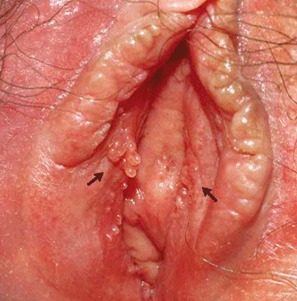
A 25 year old woman presents to your office with history of genital lesions. The patient says that she has has read about genital warts on the internet and is now very concerned that she might be suffering from the same. She is sexually active with her boyfriend and does not want him to get infected with her condition. Physical examination reveals lesions that are are flesh-colored, soft pearly papules found on the inner aspects of  labia minora which are  symmetrically distributed on  either side of the vulva and are easily seperable from each other.

A concerned woman in a doctor's office. What is the Next Step?

Next Step in the Management:

A) Topical Imiquimod

B) Trichloroacetic Acid

C) Treat both patient and her partner with Podophyllin

D) Re-assurance

E) Oral Acyclovir

Copy Rights: USMLEGalaxy

Question of the Week # 34

•A 10 y/o boy is brought by his mother for extensive rash on his lower extremities that started one day ago and has been worsening. There is no history of fever . The family just returned four days ago from a camping trip and the mother does not recall any exposure to ticks except that the boy stepped in to a bush while walking downhill. On examination, there is extensive erythema along with vesicles and bullae on the front and the back of bilateral lower extremities up until the level of the knees. The upper portion of the lower extremities is unaffected. The rest of the physical examination is normal. The best treatment for the management of this child’s condition is : •

A. Topical triamcinolone •

B. Prednisone orally •

C. Ceftriaxone intra-muscular •

D. Diphenhydramine •

E. Observation

Copy Rights: USMLEGalaxy

Question of the Week # 29

A 10 year old girl who is a Jehovah’s witness is brought to the ER after a car accident. She needs IV fluids and transfusions. The mother refuses consent for fluids and transfusions, saying its against her religious beliefs. Your next step: 

A.  Order the fluids and transfusions, overruling the mother.
B.  Get an emergency court order 
C.  Get an emergency ethics consult
D.  Agree with the mother and not give the treatment

Copy Rights: USMLEGalaxy

Question of the Week # 31

Q31) Lisa was one of your patients 2 years ago. While Lisa was in NJ she has been your regular patient for her depression. She trusts and respects you a lot. She even told you earlier that she would be very lucky if she could date a person like you at least once in her lifetime. She is a beautiful 25 year old whom any man would like at a first sight. You have lost contact with Lisa and she has not been your patient for past 2 years because she moved to Florida. She happens to meet you incidentally at a mall and requests that you go for a date with her the following weekend. Your response should be:

A) Tell her that since she no longer your patient you can get involved with her.
B) Refuse her proposal because its not ethical for you to do it
C) Tell her you could go for a dinner this weekend but you will not get sexually involved as that part is unethical
D) Tell her its not appropriate for her to make such advances towards her past physician
E) Tell her you would definitely get involved with her provided she signs a paper releasing you from any liability

Copy Rights: USMLEGalaxy ( excerpted from Archer Ethics Lectures)

Question of the Week # 14

A 46 y/o woman who is a school bus driver by occupation presents to your office for regular follow up. She has a history of  ADPKD. Her blood pressure is well controlled at 120/70 on enalapril. She has no other problems. She denies any headache. There is no family history of intracranial or subarachnoid hemorrhage. However, she is concerned that her head might explode because her sister who also has ADPKD was recently diagnosed of having a berry aneurysm. She wants to be screened for berry aneurysm as soon as possible. Her physical examination is benign and does not reveal any focal neurological deficits. Which of the following suggests the necessity for screening in her case?

A. Family history of berry aneurysm
B. Polycystic kidneys
C. School bus driving
D. Cysts in the liver
E. No screening necessary in her case

Copy Rights: Archer USMLE Reviews

Questions of the Week # 12, 13

Q12) A 12 y/o boy is brought to you by his mother for skin rash and complaints of intermittent abdominal pain, joint pains for past 2 days. He did have an upper respiratory infection about 2 days ago. On physical exam, his vitals are normal. Abdomen is benign with out any tenderness or rigidity. However, you notice patchy purple discolorations on his extremities and the back. Lab studies are obtained that revealed

WBC: 6.6 , HGB: 15.3 , MCV: 88 , Platelets: 290,000 ( normal 180k to 400k)
BUN: 11 , Creatinine : 0.6 ( normal) , Anti streptolysin O titer : negative
Streptozyme : negative ,Urine dipstick : normal without any blood
Urinalysis : normal/ no rbcs/ no protein
The mother is very anxious and asks about the long term prognosis of her son. Your response :

A) Reassure the mother that boys disorder is self limiting and does not require any follow up
B) Tell her the boy needs to be admitted and treated vigorously to prevent renal failure
C) Tell her that renal failure develops 100% of such cases and hence needs very cautious follow up
D) Tell her that 50% of such cases progress to end stage renal disease.
E) Tell her that the boy requires follow up monthly urinalysis for at least 3 months in order to make sure there is no heamaturia/ renal dysfunction.

Q13) If the boy presented with Renal failure in the above case, the most likely underlying pathology would be :
A) IgA mediated vasculitis
B) Post streptococcal glomerulonephritis
C) Anti GBM disease
D) Acute tubular necrosis
E) Interstitial Nephritis.

Copy Rights : Archer USMLE Reviews

Question of the Week #11 – Archer USMLE Step 3

A 7-year-old boy is brought to the emergency department by his mother because of “tea-colored urine” for the last several days. He has also had some nausea and vomiting, and his eyes appear swollen when he wakes up in the morning. The eye swelling tends to resolve over the course of the day. He is generally very healthy and there is no family history of any chronic diseases. His temperature is 36.7 C (98.0 F), blood pressure is 130/90 mm Hg, pulse is 96/min, and respiratory rate is 16/min. Physical examination is unremarkable. A urinalysis shows red cell casts. At this time the most appropriate study to confirm your diagnosis is

A. antinuclear antibody
B. antistreptolysin O antibody
C. renal biopsy
D. renal ultrasound
E. urine culture

Question of the Week # 10

•A 55 y/o man presents with shortness of breath on exertion. Laboratory studies reveal iron deficiency anemia. Patient was started on Iron pills orally. The patient consumes a lot of red meat and was surprised to know that he was iron deficient. Fecal occult blood testing revealed a positive stool guaic. A colonoscopy and EGD were subsequently performed which were absolutely normal. A repeat Guaic was performed and was found to be negative. A further investigation for the cause of iron deficiency in this patient revealed celiac disease leading to iron malabsorption. What is the most likely cause of positive Guaic in this patient? •

A. Obscure GI Bleeding

B. Celiac disease

C. False positive from red meat

D. False positive from Iron pills

E. Colon cancer

Copy rights: Archer USMLE Reviews

Question of the Week # 9

A 65 y/o man with history of chronic smoking and COPD presents for follow up visit in your office after being discharged from the hospital about three weeks ago. The patient was admitted and treated in the hospital for community acquired pneumonia and COPD exacerbation. During his hospital stay he was noted to have microscopic hematuria on routine urinalysis. The patient denies any symptoms now. His COPD is well controlled on tiotropium inhaler. His allergies include Isoniazid and Penicillin. Past medical history is significant for a positive PPD test ( latent tuberculosis) for which he has been on treatment with Rifampin for past three months. Physical examination is benign. Labarotory investigations reveal a normal CBC and serum creatinine. Dipstick is positive for blood. A repeat urinalysis during this visit reveals persistent microscopic hematuria with 3 RBCs/HPF. A urine cytology has been ordered. The next appropriate step in evaluating this patient’s hematuria is:

A) Repeat urinalysis in 3 months
B) Non-Contrast CT scan
C) Intravenos pyelogram
D) CT urogram + Cystoscopy
E) Stop Rifampin

Question of the Week # 8 – Archer USMLE Step 3

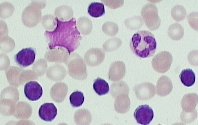
A 72 y/o man with hx of chronic alcoholism and smoking presents to your office with extreme fatigue. Denies any fever or weightloss or nightsweats. Vital signs were normal and physical examination reveals generalized small lymphadenopathy and mild splenomegaly. Laboratory studies reveal CBC with hgb 9.5, wbc 10k with 25% neutrophils, 65% mature lymphocytes and 9% monocytes, platelets 90k. LDH is increased at 600 and reticulocyte count of 8.0% . Haptoglobin level is 22mg% ( N 27 to 160) and urinary hemosiderin level is with in normal limits. Basic metabolic panel, Vitmain B12 and Folic acid levels are within normal limits. Peripheral smear is shown below and reveals many Smudge cells.

Archer USMLE Step 3 QBANK

Most likely etiology of this patient’s Anemia is :

A. Microangiopathic Hemolysis

B. Bone marrow infiltration with Chronic Lymphocytic Leukemia

C. Acute Lymphoblastic Leukemia

D. Autoimmune Hemolysis

E. Hypersplenism

Copy Rights: USMLEGalaxy

Question of the Week # 5

A 30 y/o pregnant woman has a one week history of a slowly enlarging red lesion on her right thigh. She reports having gone on a camping trip about 3 weeks ago and now recalls that she removed a tick from the site of the lesion. An ELISA test is negative for Lymes. Upon further questioning, she also reports contact with poison Ivy like  bushes during the same camping trip.

Archer USMLE Step 3 Qusetion Bank

What is the next step?
A. Re-assurance
B. Ampicillin
C. Doxycycline
D. Western blot testing
E. Topical Corticosteroid

Question of the Week – Wk#1

Archer will start  “Question of the Week” series starting today. Every week Archer Review will post most challenging questions that include close distractors in the choices that are often tested on USMLE Step 3.

Question of the Week – July 29th 2010

1. A 15 year old boy presents to emergency room with severe lower abdominal pain that awoke him from sleep about 5 hours ago. The pain is sharp and radiating to the left thigh. While in the emergency room, the patient has one episode of vomiting. He denied any fever, dysuria or chills. Physical examination reveals normal vitals with blood pressure 100/60 and temperature of 98.6F. Abdominal examination is relatively benign. Scrotal examination reveals an elevated left testis that is diffusely tender to palpation. Cremasteric reflex is present on the right but absent on the left. Most important next step in managing this patient :
a. CT scan Abdomen and Pevlis
b. Testicular Ultrasound
c. Surgical Exploration
d. Intravenos Antibiotics
e. Plain X-Ray KUB

Answer will be posted with in 3 days. You may submit your responses and analysis as a comment to this post.

Copy Rights : USMLEGalaxy, LLC

Archer USMLE Step 3 Customer Satisfaction Survey

Please kindly complete the following survey. Your responses will help us to serve you better and improve Archer Review further. Archer Review was launched in 2008 and has always relied on customer feedback to improve it’s courses further. Today, Archer Review reaches about 8000 USMLE takers, residents and medical students each year. Your honest feedback has helped us reach this position and we remain as grateful as ever for making this review course most helpful and successful choice for the prospective USMLE examinees.

Archer Review Survey

Archer – Critical Care

Topic I Pulmonary Embolism

Pulmonary embolism is a highly questioned topic on USMLE Step 2 and Step 3. Many students have questions and concerns regarding :
1. Stable vs. Unstable PE. Diagnosis/ clinical scenarios
2. Acute management of stable vs. unstable Pulmonary embolism
3. Indications for IVC filter ( Greenfield filter)
4. Duration of anticoagulation
5. Hypercoagulability work-up

We will discuss these here in three parts and self assessment questions will follow after the discussion.

Chapter I – Clinical scenarios – Acute PE.

1. Pulmonary embolism can manifest in several ways. You need to familiarize yourself with various clinical scenarios associated with PE that can be often tested on the exam. Commonest symptoms would be chestpain and/ or shortness of breath. But other scenarios that can be tested are : ( You should consider and rule out the possibility of PE in the following scenarios)

a) Acute onset atrial fibrillation in an immobilized hospitalized patient.
b) Shock with no other obvious causes in a patient with risk factors for PE
( Obstructive shock – understand that the embolus can be massive and occlude the right ventricular outlet i.e; pulmonary artery there by preventing filling of the left heart leading to shock)
c) Persistent tachycardia in a patient with risk factors for PE.
d) Hypoxemic respiratory failure with increased A-a ( alveolar-arterial gradient)
e) Sudden right ventricular strain pattern on the EKG ( Typical S1Q3T3 pattern on EKG -sudden onset).
f) Pumonary Hypertension ( If chronic and no other etiology, suspect and rule out chronic thromboembolism in patients with risk factors for PE)

There are several other scenarios a PE can present in a hospitalized patient. However, the above scenarios are commonly asked on the exam. In the self-assessment questions at the end of the section, we will give you sample questions for some of these scenarios.

a) In an inpatient with acute onset atrial fibrillation – you need to control the rate with drugs like beta blocker or diltiazem but you must also consider the differential diagnosis regarding the etiology of afib such as hypoxia, electrolyte abnormalities, acute MI, valvular diseases, accelerated hypertension, hyperthyroidism and congestive heart failure. It is important to know the etiology so that you can treat the underlying issue that led to afib. Controlling the rate alone in afib is not enough , you must also address the reversible etiology so as to prevent recurrence of afib.

When you consider hypoxia as the cause, the evidence can be obtained by pulse oximetry which shows Sao2 usually less than 90 – now, you need to consider the etiology of hypoxia – is it a hypoventilation as in COPD or is it a deadspace such as in pulmonary embolism or is it shunting as in collapse, pneumonia or ARDS? Such information can be obtained by ordering initial tests such as arterial blood gases and chest x-ray. Calculate the A-a gradient from the blood gases. ABGs give important clues – presence of hypercapnia usually indicates COPD/ opiod overdose etc as the causes of hypoxia. Presence of hypocapnia with low po2 and increased A-a gradient goes more in favor of pulmonary embolism.

If chest x-ray is normal but A-a gradient is increased on the ABGs, you should question yourself on what could be possibly causing the gradient with out any evidence of obvious disease on the CXR. This most likely indicates underlying pulmonary embolism in which case you need to pursue further tests to diagnose it such as V/Q scan or Spiral CT scan. Such an analytical approach will allow you to choose the correct diagnosis.

b) Shock – shock is mainly of four types such as Hypovolemic, cardiogenic. distributive and obstructive. Understanding this simple basic pathophysiology behind shock can help you diagnose the etiology of shock and there by, institute life saving therapy.
Pulmonary embolism can cause obstructive shock i.e; hemodynamically unstable PE. This is also referred to as Acute corpulmonale ( Acute right ventricular failure). Diagnosing PE as the cause of shock is very important because immediate thrombolysis can lyse the thrombus that is obstructing the right ventricular outlet there by, restoring left ventricular filling and the blood pressure. Hence, it is a life saving decision to give thrombolytics in a hemodynamically unstable PE.

c) In any patient with persistent tachycardia with out obvious causes, one should consider if this patient is at risk for PE. If the patient has risk factors for PE, then a v/q scan or spiral CT must be obtained to rule out PE.

d) As mentioned above, hypoxemic respiratory failure in the presence of normal chest x-ray and increased A-a gradient on the ABGs strongly suggests PE as a possiblity.

e) Acute right ventricular strain can be presented to you in the form of an EKG with a typical S1Q3T3 pattern on the EKG or ST elevation in I or t-inversions in lead III. Always, it is important to rule our right ventricular MI or ischemia in these cases because such an MI can also cause similar changes. Obtaining cardiac enzymes is helpful to consider acute MI when there is elevated troponin but it should be remembered that a massive PE can also cause some elevation in troponin. So, best test in such a scenario where there is acute right ventricular strain pattern on the EKG would be a 2D-Echocardiogram. 2D-Echo will help you see wall motion abnormalities – if only some or single segment of the right ventricle wall are hypokinetic, it favors right ventricular MI. If the entire right ventricle is hypokinetic, it goes more in favor of Pulmonary embolism ( imagine a massive clot obstructing the right ventricle outlet, obviously, the entire right ventricle will not move – seen as global hypokinesis of RV on the 2D ECHO)

The above mentioned are some unique confusing scenarios in pulmonary embolism presentation. In the next chapter, we will discuss the diagnosis and management of stable vs. unstable PE

Self Assessment Questions:

1) A 75 year-old man with history of hypertension presents to the emergency room with complaints of shortness of breath and palpitations. His vital reveal a heart rate 142/min, blood pressure 130/86, temperature 98.6 and oxygen saturation of 89% on room air. On auscultation, there are no rhonchii or crepitations, the heart rate was irregular and rapid with out any murmurs. The patient is placed on oxygen by nasal cannula. An urgent EKG is obtained which reveals rapid atrial fibrillation with no evidence of significant ST-T changes. The patient is started on diltiazem. Chest x-ray is normal and a brain natriuretic peptide is 80ng/L. Electrolytes, TSH and complete blood count are with in normal limits. Cardiac enzymes are drawn. Arterial blood gases reveal a pH of 7.48, po2 of 58, pco2 of 20 on room air ( Fio2 of 21%). The next step in establishing the etiology of his atrial fibrillation :

A) Cardiac catheterization
B) Spiral CT scan of the chest
C) Venos doppler of lower extremities
D) 2D Echocardiogram
E) D-Dimer

2) What is the most likely etiology of atrial fibrillation in Case 1?

A) Acute ST elevation MI
B) Acute pulmonary embolism
C) Pneumothorax
D) COPD exacerbation
E) Congestive heart failure

3) A 65 year-old man with history of recently diagnosed metastatic colon cancer being treated with chemotherapy is admitted to the hospital with constipation and vomiting. His colon cancer was diagnosed by colonoscopy 2 months ago when he presented with massive GI bleeding. At this admission, patient is diagnosed with bowel obstruction secondary to descending colon cancer and underwent a palliative left hemicolectomy to provide symptomatic relief. He has no occult or gross GI bleeding at this time. On the sixth post-operative day, you are called by the nurse because the patient’s blood pressure is 80/40. His heart rate is 82, respiratory rate 24 and temperature of 100.6. The patient is given Normal saline bolus. A CXR is normal. EKG reveals a prominent S wave in lead I, a Q wave and inverted T wave in lead III. Of note, a pre-operative EKG was completely normal. First set of cardiac enzymes are negative. A bedside 2D echo reveals global hypokinesis of the right ventricle. A repeat blood pressure obtained after normal saline bolus is still low at 70/40. The most likely etiology of the shock in this patient is :

A) Hypovolemia
B) Septic shock
C) Acute myocardial infarction leading to cardiogenic shock
D) Acute pulmonary embolism
E) Tension Pneumothorax

4) Most important next step in treating this patient’s shock?

A) Continued fluid boluses
B) Antibiotics and pressor support with dopamine
C) Intra-aortic balloon counter-pulsation followed by urgent cardiac catheterization.
D) Anticoagulation with heparin
E) Tissue plasminogen activator ( tpA)
F) Embolectomy
G) Chest tube placement.
H) Inferior vena cava filter

5) The patient was appropriately treated. The discharge recommendations should include :
A) Inferior venacava filter
B) Life-long low-molecular weight heparin
C) Life-long coumadin
D) Hypercoagulability testing
E) Compression stockings

Q1) Ans. D
– 2D echocardiogram in this case will help to evaluate for different etiologies of atrial fibrillation such as acute MI, acute PE and valvular heart disease. From the question, we understand that hypoxia could have possibly initiated the atrial fibrillation. A normal CXR rules out gross lung pathologies such as emphysema, pneumothorax, ARDS, pulmonary edema and pneumonia which could be various etiologies of hypoxia. However, pulmonary embolism and acute MI can not be readily eliminated from a normal Chest X-ray. Hence, a quick bed side echo should be considered. If the Echo reveals segmental hypokinesis of right ventricle, this favors the diagnosis of Acute MI where as if it revealed a global hypokinesis of the right ventricle, it would more favor a diagnosis of acute pulmonary embolism.

– Spiral CT scan is a close distractor here since one may choose this considering the strong diagnosis of pulmonary embolism in the above case. However, spiral CT scan will help you to confirm or rule out PE but it does not help you to evaluate for other possible etiologies of atrial fibrillation at the same time. Hence, 2D echo is a superior initial test in the above case.

– Urgent cardiac catheterization should be performed in the presence of ST elevation MI. There is no evidence of ST elevation in the above case.

– Venos doppler of lower extremities should be considered once we are more certain that PE is the most likely etiology and hence, is not an initial test.

– D-Dimer can be used as a screening test for PE when the pre-test probability is low. A low D-dimer combined with a low pre-test probability of PE can be used to rule out PE. While a low D-dimer < 500 may exclude PE, a higher d-dimer is non-specific and does not differentiate between other causes of thromosis such as DIC, presence of arterial thrombi, PE and DVT.

Q2) B.
The presence of Hypoxia, hypocapnia and increased A-a gradient (about 70) with a normal CXR findings in the above question indicates that an Acute Pulmonary Embolus is the most likely diagnosis.
Choice A – is not the answer because the EKG did not reveal any ST elevations.
Choice C – is not the answer since the physical exam revealed normal breath sounds and CXR was normal.
Choice D – is not the answer since the ABGs in the above patient reveal Hypocapnia and increased A-a gradient. Hypercapnia secondary to acute CO2 retention is often a feature of COPD exacerbation. The A-a gradient is usually normal in COPD except in emphysema.
Choice E – a normal CXR, absence of significant CHF physical findings and a BNP ( brain natriuretic peptide) less than 100 virtually rules out Congestive Heart Failure.

Q3) D.
Pulmonary embolism is a common complication that can occur in post-surgical patients, usually after post-operative day 5.
The patient has a very high risk profile for pulmonary embolism. The clinical probability of the PE from his history is extremely high – age > 60 years, cancer, immobilization and surgery with in last few days are well known risk factors for pumonary embolism which this patient clearly possess. Also, sudden appearance of right ventricular strain pattern (S1Q3T3) and a classic acute corpulmonale findings on 2D Echo suggests that PE is the most underlying etiology for this patient’s shock. ( Obstructive type shock)

Although. all the other choices are potential causes for shock in the above patient, their probability can be reduced by considering and analyzing important clues in the question.

– Choice A not correct – Failure to respond to normal saline indicates that this is not hypovolemia. Also, hypovolemic shock should not produce acute right ventricular strain on the EKG or hypokinesis on the 2D Echo.

– Choice B not correct – Fever may suggest sepsis but it needs to be remembered that fever can also be seen with PE. Also, septic shock should not produce acute right ventricular strain on the EKG or acute right ventricular hypokinesis alone on the 2D Echo.

– Choice C not correct – Acute MI is a possiblity but it usually produces segmental hypokinesis rather than global hypokinesis on 2D Echo. The cardiac enzymes are also negative.

– Choice E not correct since CXR was normal.

Q4) F.
Pulmonary embolectomy is the correct choice. In scenarios where thrombolysis is contraindicated, embolectomy is used for patients with PE who are hypotensive despite supportive measures (persistent systolic BP ≤ 90 mm Hg after fluid therapy and O2) i.e; hemodynamically unstable PE.
The patient has obstructive shock and obstruction should be removed urgently to restore the blood pressure. Clot can be lysed by thrombolysis or mechanically with embolectomy. The patient had GI bleeding in last 6 months which is an absolute contraindication to thrombolysis and also, surgery 6 days ago which is a relative contraindication for tpa. Hence, embolectomy is the choice.

Choice A – not correct – this is the treatment of hypovolemic shock. Hypovolemic shock is unlikely because of the above mentioned reasons in this patient.

Choice B – not correct – this is the treatment of septic shock. Septic shock is unlikely because of the above mentioned reasons in this patient.

Choice C – not correct – this is the treatment of cardiogenic shock. Cardiogenic shock is unlikely because of the above mentioned reasons in this patient.

Choice D – not correct – this is the treatment of stable pulmonary embolism. In unstable pulmonary embolism, clot obstruction must be relieved rapidly with thrombolysis or embolectomy. If tpa is planned, Heparin should only be started 24 hours after thrombolytics. Heparin will help in preventing further clot extension or further embolism but will not help in immediately treating the obstructive shock.

Choice E – not correct – The patient has contraindications for tpa ( thrombolytics). Absolute contraindications to thrombolytics include prior hemorrhagic stroke, ischemic stroke within 1 yr, active external or internal bleeding from any source, intracranial injury or surgery within 2 mo, intracranial tumor, GI bleeding within 6 mo, and CPR.

Relative contraindications include recent surgery (≤ 10 days), hemorrhagic diathesis (as in hepatic insufficiency), pregnancy, current use of anticoagulants and an INR > 2, punctures of large noncompressible veins (eg, subclavian or internal jugular veins), recent femoral artery catheterization (eg, ≤ 10 days), peptic ulcer disease or other conditions that increase the risk of bleeding, and severe hypertension (systolic BP > 180 or diastolic BP > 110 mm Hg).

Choice G – not correct – This is the treatment for tension pneumothorax. Tension pneumothorax is an important cause of obstructive shock but a normak CXR rules it out.

Choice H – not correct – this is the treatment for pulmonary embolism or DVT in the presence of contraindications to anticoagulation with heparin or warfarin or in cases of warfarin failure.
Indications for IVC filters:
– Contraindications to anticoagulation
– Recurrent DVT (or pulmonary emboli) despite adequate anticoagulation ( i.e; warfarin failure)
– In patients with low cardio-pulmonary function and extensive DVT ( extending in to inferior venacava) – where any additional small pulmonary emboli may compromise their cardio-pulmonary status further.

Q5) B.
LMWH is superior to warfarin in preventic venos thromboembolism in cancer patients. Cancer is a hypercoagulable condition and this patient hence, requires life-long anticoagulation.
Choice A is incorrect. IVC filter is indicated for thromboembolism prophylaxis in the presence of absolute contraindication to anticoagulation. The patient has no active bleeding. Also, IVC filter can only protect against PE but not against DVT .
Choice C is incorrect because LMWH is superior to warfarin in cancer patients.
Choice D is incorrect – the patient already has a known hypercoagulable state which is a cancer and requires life long anticoagulation with LMWH. This is not a idiopathic PE where full hypercoagulability work-up would be warranted.
Choice E is incorrect – compression stockings are more effective for preventing calf than proximal DVT and thus, provides inadequate prevention. Also, they are contraindicated in patients with active DVT or those with possible occult DVT as compression can dislodge the clots and lead to PE in those with active DVT.

USMLE Step 3 CCS WORKSHOP – MAY 2010

Archer online live step 3 reviews aims to bring USMLE step 3 courses on your desktop, at your doorstep! These highly successful live USMLE Step3 online reviews are an extension of our very popular and successful ” Dr.Red’s online ccs workshop, which has reached more than two thousand step3 takers in less than 12 months and has resulted in 98% pass rate. Archer Reviews have achieved a high success rate even with examinees with multiple attempts by our unique approach. These online reviews are done live and in a webinar format. You can stay at home and listen to lectures live and like in a virtual classroom, you can raise your hand and your question will be immediately answered by the instructor. This is a live online classroom which reduces the pain of flying several miles to attend live reviews. These are the only one in the market that offer successful step 3 lectures in this unique, live format. Archer’s most successful endeavor has been Dr.Red’s CCS Workshop which has helped hundreds of examinees to pass easily by excelling on CCS component.

Archer’s next CCS online workshop for the month of January will be on Sunday 1/24/2010 at 10 AM EST.

If you are interested in registering for this course, you can pay for the course on the website at http://www.shop.ccsworkshop.com. Upon payment of the registration fee, your registration request will be automatically approved and an approval e-mail will be sent to you. This approval notice will have a button “Join Webinar” in it. Clicking this button on the day of the workshop will open up the live workshop on your desktop

To participate in the workshop, you will need a computer with internet access. For the audio, you can use either your computer’s microphone or a telephone. You will use the phone for the voice and log in to the conference call while you watch the power-point slides and the CCS demonstration on your desktop via. our unique net meeting software. You can also just opt to use your computer’s microphone in which case you do not need a telephone. Then you will get to practice a case while we watch and analyze your approach and correct it.

CCS Workshop Includes :

1. Lecture on CCS Strategies
2. Live demonstration of CCS cases
3. Common mistakes committed by the examinees and preventing them
4. Tips to score extremely high on CCS
5. Follow-ups of office and ER cases
6. Efficient use of time, doing more stuff without advancing the clock
7. Avoiding invasive tests
8. Basic set of orders for emergency cases
9. The 5-minute screen – adding/ disconinuing the orders that can matter
10. Obtaing consults and their appropriateness
11. Differential diagnosis for common ER and office presentations and easy tips to get the most out of few orders.
12. Working on efficiency
13. Live practice of 15 to 20 CCS cases by the attendees in the workshop
14. A these in addition to –> 20 minutes of supervised practice of one CCS case by each attendee who volunteers to practice. About 15 to 20 Highyield CCS cases will be practiced. During this time, you will be thoroughly analyzed, corrected and given instantaneous feedback by our experienced faculty

The total course fee is $97 .Slots are limited at 45.
If you are interested in the course, you visit Archer’s online store directly to pay : http://www.shop.ccsworkshop.com

If you have further questions, please directly contact support@ccsworkshop.com

Archer’s other courses include very informative topic reviews and the high-yield rapid review – please check our website. Next 3-Day Step 3 Rapid Review is in JULY -2010. Archer theory reviews are now available as streaming videos so that you can start accessing them from the beginning of your step 3 preperation and fine tune your conceptual understanding to score maximum on the Multiple Choice Questions on USMLE Step 3.

Archer live Online CCS Workshop – September 2009

Archer Live Online USMLE Step3 CCS Workshops from http://www.CcsWorkshop.com

Archer’s online live step 3 reviews aims to bring USMLE step 3 courses on your desktop, at your doorstep! These highly successful live USMLE Step3 online reviews are an extension of our very popular and successful ” Dr.Red’s online ccs workshop, which has reached more than two thousand step3 takers in less than 12 months and has resulted in 98% pass rate. Archer Reviews have achieved a high success rate even with examinees with multiple attempts by our unique approach. These online reviews are done live and in a webinar format. You can stay at home and listen to lectures live and like in a virtual classroom, you can raise your hand and your question will be immediately answered by the instructor. This is a live online classroom which reduces the pain of flying several miles to attend live reviews. These are the only one in the market that offer successful step 3 lectures in this unique, live format. Archer’s most successful endeavor has been Dr.Red’s CCS Workshop which has helped hundreds of examinees to pass easily by excelling on CCS component.

Archer’s next CCS online workshop for the month of September will be on Sunday 09/20/09 at 10 AM EST.

If you are interested in registering for this course, you can pay for the course on the website at http://www.shop.ccsworkshop.com. Upon payment of the registration fee, your registration request will be automatically approved and an approval e-mail will be sent to you. This approval notice will have a button “Join Webinar” in it. Clicking this button on the day of the workshop will open up the live workshop on your desktop

To participate in the workshop, you will need a computer with internet access. For the audio, you can use either your computer’s microphone or a telephone. You will use the phone for the voice and log in to the conference call while you watch the power-point slides and the CCS demonstration on your desktop via. our unique net meeting software. You can also just opt to use your computer’s microphone in which case you do not need a telephone. Then you will get to practice a case while we watch and analyze your approach and correct it.

CCS Workshop Includes :

1. Lecture on CCS Strategies
2. Live demonstration of CCS cases
3. Common mistakes committed by the examinees and preventing them
4. Tips to score extremely high on CCS
5. Follow-ups of office and ER cases
6. Efficient use of time, doing more stuff without advancing the clock
7. Avoiding invasive tests
8. Basic set of orders for emergency cases
9. The 5-minute screen – adding/ disconinuing the orders that can matter
10. Obtaing consults and their appropriateness
11. Differential diagnosis for common ER and office presentations and easy tips to get the most out of few orders.
12. Working on efficiency
13. Live practice of 15 to 20 CCS cases by the attendees in the workshop
14. A these in addition to –> 20 minutes of supervised practice of one CCS case by each attendee who volunteers to practice. About 15 to 20 Highyield CCS cases will be practiced. During this time, you will be thoroughly analyzed, corrected and given instantaneous feedback by our experienced faculty

The total course fee is $97 .Slots are limited at 45.
If you are interested in the course, you visit Archer’s online store directly to pay : http://www.shop.ccsworkshop.com

If you have further questions, please directly contact support@ccsworkshop.com

Archer’s other courses include very informative topic reviews and the high-yield rapid review – please check our website. Next 3-Day Step 3 Rapid Review is in September -2009

Archer launches PayPerView for USMLE Step 3 audio/video lectures

Archer Review releases Pay-Per-View option for those who missed out on their live reviews
Pay-Per-View enables you to watch the streaming video lectures for USMLE step 3 at your own convenience. These recordings are similar to the live webinar review in that you can see the powerpoint presentation running on your desktop screen while you also listen to the instructor’s audio.

Archer Review answers some of the frequently asked questions regarding Pay-Per-View
Please see below

What is Pay-Per-View?
Pay-Per-View system allows you to access the streaming video lectures online at your convenience and watch them at your home on your own desktop. You may purchase the full length course or topic-wise access.

Can I watch a Demo?
Yes! Contact us

What lectures for USMLE Step 3 do you currently offer via. Pay-Per-View?

The lectures that are currently available via. Pay-Per-View areA. Archer Full length ( 36 hours) USMLE Step 3 Review Course. B. Archer USMLE 3 Topic-Wise Lectures ( Hematology, Cardiology, Gastroenterology, Nephrology/Acid-base/Electrolytes, Pulmonology/Ventilators, Infectious diseases, Endocrinology, Neurology, Ethics, Rheumatology/ orthopedics/ sports medicine, Oncology, Preventive medicine, Psychiatry, Gynecology, Pediatrics and Dermatology )C. Lectures for USMLE Step2 CK will be available very soon.

What are these Video Lectures? Are they similar to your live reviews?

These streaming video lectures are the recordings of our live webinar sessions. These are exactly similar to our live review in that you can see both the powerpoint presentation ( a capture of the instructor’s desktop screen) as well as listen to the audio in conjunction with the powerpoint presentation. This eliminates the need for looking at a hand out or notes while listening to the lecture as you can directly see the powerpoint running on your screen.

Are we provided with any hand-outs or lecture notes?

Yes, you will be provided with relevant Archer USMLE Step 3 notes by e-mail once you purchase the streaming video for a particular topic or for the entire review.

Is Pay-Per-View more expensive than live review?

At this time, the cost of live review as well as Pay-Per-View is similar.What are the benefits of Pay-Per-View over the Live review?Live review needs to be attended at a designated time. Pay-per-view can be watched at your convenience. In Pay-Per-View, you can pause and listen to a particular portion again. You can also listen to the same lecture almost one and half times with the “watch time” that we currently provide.

What are the limitations of Pay-Per-View when compared to Live Review?

During the live review, you can directly ask questions and talk with the instructor. There is no such possibility via. Pay-Per-View. However, you may send us questions by e-mail and our instructor will try and answer them in about 3 days.

What is “Watch Time”?

Watch time is the amount time you are provided to watch the lecture. You are approximately provided with a watch time that is 50% greater than the length of the review. This allows to rewind and replay certain portions of the lecture if you wish. Watch time will not expire when you exit the lecture. Any unused watch time will be stored in your account and you can use it on an other day. When you resume the lecture, make sure to forward the player to the point where you left off. You can also replay the previous session as long as you have sufficient watch time in your accountFor each lecture, you will be provided with the duration of the lecture and the “Watch time” when you begin.

Do I need any special system requirements to play these?

These are WMV files and will play with any Windows Media Player.

How about the Internet connection requirements?Dial-Up connections are ok but broad band connection is preferred for uninterrupted access.

If interested, please visit Pay-Per-View to sign up!

Hematology for USMLE Step 3 – Archer Review

Pay-Per-View

Cardiology clip – Archer USMLE Step 3 Live Rapid Review

Due to codec issues, the video is not showing up in the above clip. If you need video access, please click here

A detailed video clip on stress tests and cardiac work up will be soon posted here on the blogs!

Archer USMLE Step 3 Live Rapid Review – A Webinar! Access it from Home!

Archer Online Step III review is the most unique way to listen & participate in the live reviews with out leaving your home. This innovative lectures have reached about 800 people in the last 6 months and have achieved a very high success rate. It is our practice to mail a survey to the attendees after each Rapid Review and CCS Workshop – about 100% of our attendees rated us “Very helpful”, “Extremely patient”, ” Very affordable” and “Very focused and highyield”. Almost 95% felt that they did not need any other review material for step 3 preperation apart from our powerpoint slides and live lectures.

The review is very affordable at $295 ( $50 off for early registrants until May 12th 009) and includes 26 hours of rapid live lectures and all the high-yield study material for all the topics mentioned below. The idea of the rapid review is to focus on most frequently tested Step3 clinical topics which are usually not clearly explained in many review books that are available on the market. This review intends to make step3 live lectures extremely affordable and easily accessible for everyone.

The rapid review online virtual classroom will be in the same way as CCS Workshop. You can raise your hand when you have a question and your question will be answered at the end of each sub section. We recommend you to write down all the questions as the topic lecture runs. At the end of each sub-section, our teaching physician will be available for you to answer your questions. This course is three-day cumulative session of about 26 hours long, stresses on high-yield topics and step3 questions. No extensive details – you will be provided with explainations on the concepts that are exactly needed to pass and score high on this exam. You will be quizzed during the session with sample questions after the topic Review. Extremely interactive with personal attention placed on each and every attendee. After you sign up, you will be provided with high-yield study material in a power-point format.
Our first two Rapid reviews were 2-day long (20 hours) in duration. But with a desire to cover more topics, we extended it now to 3-day (26 hour) long review in April 2009 ( 4/17 to 4/19). This review worked out very well and received a huge applause from the attendees. At this time the plan is to do this review on June 12th, 13th and 14th in the following format spread over 26 hours in three days.

Each day starts at 10 AM EST ( except Day I)

Day I – Friday ( 3 Hours) – June 12th 2009

7:00 PM to 9:00 PM EST – Preventive Medicine ( Topics – Smoking cessation, vaccinations, Lipid screening, Antibiotic prophylaxis prior to surgery, prevention of osteoporosis, steroid induced osteoporosis, Cancer screening discussed under oncology, AAA screening)

9:00 PM to 10:00 PM EST – Psychiatry/ ethics

DAY II Saturday(11.5 hours ) – June 13th 2009

10 to 12:30 pm – Cardiology
12:30 to 1:00 PM – Lunch BREAK
1:30 to 3:00 pm – Endocrinology
3:00 to 5:00 pm – Gastroenterology
5:00 to 5:15 – Break
5:15 to 7:15 – Pulmonary/ventilators/ critical care
7:15 to 8:45 – Infectious Diseases
8:45 to 9:00 – Break
9:00 to 9:30 – Dermatology

DAY III Sunday ( 11.5 hours) – June 14th 2009

10:00 to 12:00 – Nephrology/ Acid Base
12:00 to 1:30 – OBGYN ( Very Highyield only)
1:30 to 2:00 – Lunch Break
2:00 to 3:30 – Rheumatology/ Orthopedics/ Sports Medicine
3:30 to 5:30 – Hematology/ Oncology (cancer screening)
5:30 to 5:45– Break
5:45 to 8:00 – Pediatrics, Highyield only
8:00 to 8:15 – Break
8:15 to 9:30 – Neurology

This is a very extensive course and the price that has been set is too low to make it affordable to everyone including an IMG as well as to a medical student.. In view of price being set too low, we will not be able to do the session if a minimum number of 20 is not reached. Our last two Rapid Reviews have reached a maximum capacity of 70. Please send us an e-mail if you are interested. You will receive an invoice for $295 for this two day course and also for all the teaching slides that will be e-mailed to you in a PPT format. As soon as you sign up, you will me mailed our updated Archer rapid review notes in a powerpoint format. However, we may be adding several more highyield concepts to this notes by June 2009. In that case, we will send you the updated version of the notes again by e-mail a week before rapid review. You can also sign up for this course via. our online store at http://www.shop.ccsworkshop.com

The minimum number of enrollees is 20 and the maximum is 70.
If you have any questions, please feel free to contact us at support@ccsworkshop.com

Thank you very much
Sincerely yours,
Support Team
http://www.ccsworkshop.com
Your Key to Success!

How important is the CCS component in passing USMLE Step 3?

 Video Coming soon

A narration by Dr.Red demonstrating some sample score reports. This emphasises that CCS, even though, constitutes less than 25% of the total score, you should place equal importance on it as you do with MCQs

Excerpts from Archer Rapid Review – Nephrology by Dr.Red

this is a 30 minute clip from recent Archer USMLE Step 3 Rapid review quickly summarizing electrolyte imbalance and acid-base

The above embedded video is not displaying the video. For access to full video+ audio, click here : Nephrology

Archer USMLE Step3 Rapid Review – Samples

Rapid review sample video lectures will be posted soon after our current rapid review. Subscribe to the blog for updates!

What is the role of excelling CCS component in passing USMLE Step3?

A Commonly asked Question. Here is our analysis : http://www.ccsworkshop.com/About_us.html

Archer CCS Workshop – June 27th 2009

Interactive practice of USMLE Step3 CCS Cases.
The most time efficient strategy to pass USMLE Step 3!
A component of Archer Live USMLE Reviews.

Schedule ( Starts at 10 AM EST )

10 AM to 10:15 AM – Intro on the Webinar functions
10:15 AM to 12:15 PM – Recognizing Unstable vitals.
– General approach to ER cases
– Real time vs. Simulated time
– Strategies to keep Simulated time low (ER)
– Demonstration of high scoring strategies
12:15 pm to 12:30 pm – Q and A session
12:30 PM to 1:30 PM – Office case mangement principles
– General approach to office cases
– Indications for admisiion
– Scheduling follow up tests
– Navigating the clock with ease to score more.
– Demonstration of office cases
1:30 PM to 2:00 PM – Q and A session
2:00 PM to 2:30 PM – Lunch break
2:30 PM to 5:30 PM – Practice of very High Yield cases with one on one Q and A sessions
5:30 PM to 5:45 PM – Break
5:45 PM to 8:45 PM – Practice of Very Highyield CCS cases
8:45 PM to 9:00 PM – Break
9:00 PM to 10:00 PM – Case Practice, discussion and wrap-up!

Archer USMLE Step3 CCS Workshop Powerpoint

CCS Workshop Powerpoint

http://docs.google.com/Presentation?id=ddw827wv_1fk55bqg7 

Free Powerpoint slides from Archer CCS Workshop. Audio access and 12 hour live practice of CCS cases will be available only after sign up! To sign up, please visit http://shop.ccsworkshop.com

Archer USMLE Reviews – Group on Facebook!

Archer Usmle Reviews’s Profile | Create Your Badge
Archer Usmle Reviews's Facebook profile

USMLEGalaxy launches affordable live online USMLE Reviews!

Unique Live Review Courses

Unique Live Review Courses

USMLE Step1 and Step2 are the exams taken each year by thousands of doctors seeking admission in to various residency programs in the USA. USMLE Step3 on the other hand, is a mandatory exam that needs to be passed in order to get a license to practice as a physician in the United States. Yearly, thousands of medical graduates and students take these exams world-wide. They are usually looking for review courses that can best prepare them to ensure guaranteed success on these very competitive exams. There are several companies on the market that provide these review courses. However, most of them are expensive and also, require students to travel several hundred miles to attend their live reviews. Consequently, some students opt not to take the review courses there by, loosing the opportunity to get efficient guidance from the experts. The students that do take these courses are usually faced by time and money constraints as they are required to shell out an extra couple of thousand dollars on accomodation and travel expenses on top of what they have already paid for an already expensive live review. Some residents who are preparing for USMLE Step3 exam have huge time constraints that they cannot attend these live reviews unless they forego their valuable vacation period.

USMLE Galaxy, LLC has recognized these obstacles that limit USMLE exam takers from obtaining valubale advice and expert teaching. As an experiment, USMLE Galaxy LLC, has an initially launched USMLE Step3 Live Review courses ( Archer live USMLE Courses, Archer USMLE Step3 Rapid Review and Dr.Red CCS Workshop) through its division, http://www.CcsWorkshop.com. These reviews were a huge success and have reached about 3000 USMLE step3 examinees in a span of 8 months. Dr.Red CCS Workshop focuses on a unique way of preparing students for USMLE Step3 CCS and hence, is a grand success with consistent demand for about 2 workshops a month. Archer rapid review for Step3 was initially started as a 2 day course but now extended to 3-days. Archer USMLE Step3 rapid review attempts to cover all frequently tested USMLE Step3 topics over a duration of 26 hours. The most helpful feature of these reviews is that you can interact and participate in the live course with out having to leave your home. These reviews have been especially useful for the residents who are very busy with their training. Now, USMLE Galaxy, LLC is also releasing live, online reviews for USMLE Step1 and Step2. These reviews will be available right on your desktop and most importantly, they are live. All you need is a computer with internet access and a microphone. If you do not have a microphone, you can use a telephone to interact with your instructor. You can participate as you do in a classroom. A “hand” icon on the software lets you notify the instructor that you have a question any time during the session. Your question will be answered by the instructor at the end of each sub-topic. These reviews can be accessed from anywhere in the world.

Balaji.T, USMLE Galaxy’s ( http://www.ccsworkshop.com)(http://www.usmlegalaxy.com) Executive Vice President of Marketing said “These interactive, live sessions bring expert teaching and classroom atmosphere to your very own home. Most of our physicians are experts in teaching, have scored very high on their USMLEs and are board certified with top 10 percentile scores on the Internal Medicine board exams. We do rotate our teaching physicians to provide uninterrupted access to these live reviews. There are several review courses in the market but nothing gets more effective and extremely affordable than our unique sessions. Some companies offer online courses in a recorded format but you do not get a chance to interact with instructor in a classroom atmosphere. Eventhough, some of our future sessions will also be pre-recorded, our teaching physicians will actively supervise these lectures and after each sub-topic they will unmute you to see if you have any questions. They will actively answer all your questions during the session itself there by bringing interactive classroom atmosphere to your very own home. We have a practice of mailing surveys to our attendees after our rapid reviews. Our post-review surveys have revealed that almost 100% attendees have rated these reviews as “Very Helpful ” and “Extremely affordable”. More than 95% have commented and rated our teaching physicians as highly effective “

Hello Friends!

Welcome to WordPress.com. This is your first post. Edit or delete it and start blogging!